
Wie digitale Zwillinge in der Fahrzeugentwicklung eingesetzt werden
Anzeigen
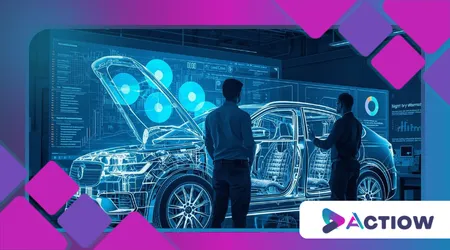
Digital Twins Are Used in Vehicle Development to turn sketches and spreadsheets into cars that already know how they’ll fail before anyone ever drives them.
Most people picture prototypes as the heroic part of car-making: the clay model under lights, the crash-test dummy waiting for impact. Reality has quietly shifted.
The real hero now lives in servers, breathing fresh data every second, aging faster than any physical car ever could.
Anzeigen
Engineers don’t wait months anymore to learn whether a suspension mount will fatigue or a battery cell will cook itself in Phoenix traffic.
They watch it happen in fast-forward, thousands of times, while the coffee is still hot.
What happens when the car you’re designing already has a full biography before the first weld?
Lesen Sie den Text weiter!
Inhaltsverzeichnis
- What Actually Is a Digital Twin When We’re Talking About Cars?
- How Does the Twin Stay Alive Across Years of Development?
- What Kinds of Wins Are Showing Up on Balance Sheets and Crash Reports?
- Why Did the Whole Industry Suddenly Decide This Was Non-Negotiable?
- Two Stories That Show the Difference Between Theory and Tuesday Morning
- What Still Keeps Smart People Awake Worrying About This Stuff?
- Questions People Actually Ask (and Answers That Don’t Sound Like Marketing)
What Actually Is a Digital Twin When We’re Talking About Cars?
A digital twin isn’t a fancy 3D render or a static simulation frozen at one point in time.
It’s a parallel life: every torque spec, every software commit, every weld bead that’s ever been planned gets mirrored and then relentlessly updated with whatever the physical world is doing right now.
Rain on a proving ground in Sweden, a heat wave in Arizona, an anonymous driver in São Paulo who likes to floor it from traffic lights—data pours in and the twin recalibrates.
The unsettling part is how quickly “good enough” stops being good enough. Early digital models were basically expensive CAD files with physics plugins.
Today’s versions argue back.
They predict thermal runaway in a battery pack six months before a physical cell would have overheated, then suggest a coolant-channel redesign that no one on the team had considered.
That constant dialogue between the thing-that-exists and the thing-that-might-exist is what makes the concept feel less like technology and more like a new kind of memory the car keeps about itself.
++ Warum Radar in einer kameradominierten Welt immer noch wichtig ist
How Does the Twin Stay Alive Across Years of Development?
It starts in the concept phase with rough geometry and performance targets nobody’s sure are even achievable.
The twin gets fed physics, material libraries, competitor tear-down data, and a wish list from marketing.
Then it runs. Not once—tens of thousands of parallel lives, most of them ending in some kind of quiet disaster.
When the first test mules roll out, the twin stops guessing and starts listening.
Real acceleration traces, vibration signatures, CAN-bus chatter flood back and overwrite the assumptions.
Later, when the line is running, the twin shadows the factory: robot cycle times, paint defects, torque wrench scatter.
Every hiccup in reality becomes training data for the next virtual iteration.
Even after the car reaches showrooms the twin doesn’t retire.
++ Wie Fahrzeugsoftware-Abonnements die Eigentumsverhältnisse verändern
Over-the-air logs keep it current; degradation curves sharpen; edge-case failures that only show up at 80,000 miles get anticipated for the facelift team.
The loop never quite closes.
++ Die verborgene Technologie hinter modernen adaptiven Fahrwerken
What Kinds of Wins Are Showing Up on Balance Sheets and Crash Reports?
Time compression is the headline most executives remember. McKinsey’s numbers still hold: serious adopters routinely shave 20–50% off development calendars.
That isn’t incremental; it’s the difference between beating a competitor to market and reading about their launch in the news.
The quieter savings live in avoided pain. Late-stage structural redesigns that once cost nine-figure write-downs now get caught when the cost is still measured in engineer hours.
Battery packs that would have needed three expensive hardware generations now converge on an optimal chemistry in one.
Warranty claims tied to thermal events or NVH issues drop because those ghosts were exorcised in simulation years earlier.
And then there’s the environmental ledger nobody talked about much five years ago.
Fewer mules built means fewer tons of steel, aluminum, and rare-earth magnets turned into landfill after six weeks of testing.
Factories that run digital dress rehearsals burn less natural gas waiting for layout mistakes to reveal themselves.
In an industry under carbon scrutiny, those grams add up fast.
| Stage | Old Reality | Twin Reality | Real-World Difference |
|---|---|---|---|
| Early validation | 8–12 physical mules | 1–3 mules + massive virtual mileage | Prototypes cut by 60–75% |
| Structural & crash | Physical barriers at €200k+ per test | Millions of virtual wall hits | Structural surprises almost gone |
| Manufacturing launch | Months of line stoppages & rework | Pre-run full sequences in virtual plant | Ramp-up 30–45% quicker |
| Field reliability | Learn from customer complaints | Predict from logged degradation curves | Warranty costs trending sharply down |
Why Did the Whole Industry Suddenly Decide This Was Non-Negotiable?
Because EVs and software-defined vehicles stopped playing by the old rules.
A modern battery management system has more lines of code than the Apollo guidance computer had in total.
An autonomy stack must handle corner cases no human test driver will ever see in ten lifetimes. Physical testing alone became mathematically hopeless.
Chip shortages and shipping chaos exposed another truth: you can no longer afford to discover you picked the wrong Tier-1 supplier six weeks before Job 1.
Digital twins let planners move entire virtual supply networks around like chess pieces until the real containers arrive on time.
Buyers changed too. They expect cars that update like phones, anticipate their habits, and never feel obsolete at 30,000 miles.
Only a living digital shadow can deliver that kind of continuous evolution without constant trips back to the drawing board.
Two Stories That Show the Difference Between Theory and Tuesday Morning
One quietly impressive case came from battery engineering at a performance EV program.
The team built a cell-level twin that tracked lithium plating, SEI growth, and gas generation across 1,200 different drive profiles.
Instead of waiting eighteen months to measure calendar aging on real packs, they watched virtual packs age three years in three weeks.
The insight that flipped the program: switching to a slightly different electrolyte additive bought an extra 14% capacity retention at 400,000 km—without touching the cell format or adding cost.
That single parameter change never would have surfaced in traditional test-matrix thinking.
The second happened on an assembly floor in Germany.
The plant needed to weave a new electric drive unit into an existing ICE line without stopping production for six months.
The digital twin of the entire facility—down to individual worker reach zones and AGV battery curves—was stood up in eight weeks.
Planners ran 1,400 different takt-time scenarios and discovered that moving one welding robot seventeen meters saved fourteen seconds per car and eliminated a pinch-point collision risk.
The physical change took three days over a holiday weekend.
No line stoppage. No heroic overtime stories. Just math that worked.
Imagine the digital twin as the car’s own lucid dream: it lives every possible life at once so the real one only has to live the right one.
What Still Keeps Smart People Awake Worrying About This Stuff?
Data hygiene is brutal. One flaky temperature sensor on a mule can poison months of predictions.
Garbage in still means garbage out, only now the garbage costs more because everyone trusts the model.
Legacy plants remain islands of proprietary protocols that hate talking to cloud twins.
Retrofitting costs real money and real political capital inside organizations that still reward silos.
And then there’s the security question nobody likes to say out loud: when your crown-jewel vehicle IP and live customer telemetry live in the same digital nervous system, the attack surface grows.
A single credential leak could expose not just one model year, but the next decade of product DNA.
Those aren’t small problems. They’re the price of moving at the speed the market now demands.
Questions People Actually Ask (and Answers That Don’t Sound Like Marketing)
| Frage | Direkte Antwort |
|---|---|
| How is a digital twin different from regular simulation? | Simulations are snapshots. Twins are alive—they ingest real data continuously and evolve with the physical asset. |
| Do you still need physical prototypes at all? | Yes, but far fewer. Certification and human tactile feedback still require metal on the road. |
| How much money are we really talking about saving? | Development budgets drop 15–40%; prototype spending falls harder; warranty costs follow later. |
| Can smaller suppliers play in this game? | Increasingly yes. Cloud platforms now offer pay-per-run access that didn’t exist three years ago. |
| Will digital twins ever completely replace crash testing? | No. Regulators want physical evidence for the books. Twins get you much closer, much faster. |
The companies already treating digital twins as infrastructure rather than a shiny demo are pulling ahead in ways that won’t show up in this quarter’s headlines—but will be painfully obvious in the next model cycle.
The rest are still learning that the future doesn’t arrive in sheet metal anymore. It arrives in data that refuses to stay quiet.
Further reading worth your time right now: